In the Why Things Fly post, we explored the four forces that keep every airplane in the sky. But there’s a detail we glossed over. What determines whether a plane can fly fast or slow, land on short runways or need miles of pavement, and stall gently or drop like a rock?
That detail is the airfoil: the specific cross-sectional shape of the wing.
Change the curve of a wing by just a few percent, and you change everything. The Wright brothers understood this instinctively. Before their first flight, they built a homemade wind tunnel and tested over 200 different wing shapes cut from sheet metal. They weren’t guessing. They were engineering.
Today, we have sophisticated computer models and decades of wind tunnel data. But the fundamental question remains the same: what shape should a wing be?
The Anatomy of an Airfoil
Every airfoil, whether on a Cessna 172, a Boeing 737, or a high-performance glider, has the same basic features.
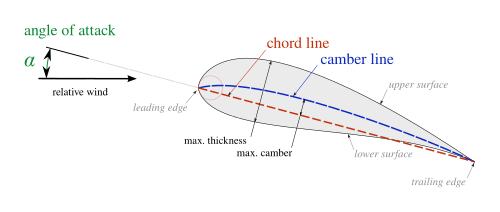
The leading edge is the front of the wing, the part that hits the air first. The trailing edge is the back, where the airflow comes back together. The imaginary straight line connecting these two points is called the chord line. The length of that line is the chord.
The actual curved surface of the wing doesn’t follow the chord line. It bends above and below it. The line that runs exactly halfway between the upper and lower surfaces is called the mean camber line, or just the camber line. The maximum distance between the chord line and the camber line is the camber.
Think of camber as the “curviness” of the wing. More camber means more curve, which generally means more lift at low speeds. But it also means more drag.
The thickness of an airfoil is simply the distance from the top surface to the bottom surface at the thickest point, usually somewhere around 30% back from the leading edge.
Why These Shapes Matter
Here’s the complicated part: there is no single “best” airfoil. A wing designed for a fighter jet trying to break the sound barrier would be terrible on a trainer aircraft landing at 60 knots. A glider wing optimized for efficiency would snap under the forces of a high-speed dive.
Like most things in aircraft design, airfoil design is a series of trade-offs.
High camber airfoils generate a lot of lift at low speeds, which makes them great for short takeoffs and landings. But all that lift comes with drag, so high-camber wings aren’t efficient for long-distance cruising.
Low camber or symmetrical airfoils are common on aerobatic aircraft and jets. They generate less lift at low speeds, but they’re efficient at high speeds and allow for smooth inverted flight. A symmetrical airfoil produces the same amount of lift (or drag) whether it’s right-side-up or upside-down.
Thick airfoils are structurally strong and can hold more fuel inside the wing, which is why airliners use them. But thick wings create more drag, especially as you approach the speed of sound.
Thin airfoils slice through the air with less resistance, which is why you see them on supersonic aircraft. The downside? They’re weaker structurally and stall more abruptly.
The Lift Curve: Where Airfoils Live or Die
Every airfoil has a lift curve, which is a graph showing how much lift it generates at different angles of attack. This curve tells you almost everything you need to know about how a wing will behave.
At low angles of attack, lift increases steadily as you pitch the nose up. The relationship is nearly linear. If you double the angle of attack (within limits), you roughly double the lift.
But push too far, and the curve hits a peak and then drops off a cliff. That’s the stall. The angle where this happens is called the critical angle of attack, and it’s usually somewhere between 15 and 20 degrees for most airfoils.
Here’s what makes airfoil design tricky: a high-camber airfoil generates more lift at a given angle of attack, but it also stalls more aggressively. A symmetrical airfoil generates less lift, but it stalls more gently and predictably.
Pilots need to know the stall characteristics of their specific aircraft because not all stalls are created equal. Some wings give you plenty of warning with buffeting, mushy controls, and a gradual loss of altitude. Others drop a wing suddenly and spin. The airfoil is a huge part of that equation.
Aspect Ratio: It’s Not Just the Shape, It’s the Span
There’s one more design element that dramatically affects performance: aspect ratio, which is the wingspan divided by the average chord.
A long, narrow wing (high aspect ratio) is incredibly efficient. Gliders have aspect ratios of 20:1 or higher because they need to stay aloft with no engine. Less induced drag means they can glide for miles on a single thermal.
A short, wide wing (low aspect ratio) is less efficient but more maneuverable. Fighter jets trade efficiency for the ability to turn on a dime. Their aspect ratios are often 3:1 or 4:1.
Most general aviation aircraft sit somewhere in the middle. Aspect ratios of 7:1 or 8:1 balance efficiency with practical structural design and hangar space. The FAA’s Pilot’s Handbook of Aeronautical Knowledge devotes an entire section to these trade-offs.
Airfoils in the Real World
Modern airliners don’t use a single airfoil from root to tip. Instead, the wing uses different airfoil shapes at different points along the span. They are thicker near the fuselage for strength and fuel storage, and thinner toward the tips for efficiency.
Many wings even twist slightly from root to tip so that the wing root stalls before the wingtips do. This keeps the ailerons effective during a stall, giving the pilot control when it matters most. This design feature is called washout.
The Cessna 172, the most-produced aircraft in history, is not the most efficient design ever made. But it’s predictable, forgiving, and stalls gently. This is exactly what you want in a trainer aircraft.
Why This Matters Before You Solo
When you’re learning to fly, your instructor will talk a lot about “feel.” How the controls respond, how the plane sounds at different speeds, how it behaves near a stall. All of that feel is a direct result of the airfoil working exactly as designed.
Understanding airfoils won’t make you land smoother on day one. But it will help you understand why the plane behaves the way it does. Why you need more right rudder in a climb, why the stall warning horn goes off at a specific pitch attitude, and why some airplanes can land slower than others.
The Wright brothers tested 200 wing shapes because they understood that flight isn’t magic. It’s physics wrapped in careful design.
And once you understand the physics, the magic gets even better.
Ready to see how much you remember from this post? Take a fun quiz!