You’re strapped into a Cessna 172 for the first time. The engine is running. Your instructor is beside you, watching. And directly in front of you is a panel full of dials, needles, and numbers.
Six instruments arranged in two rows of three. They look simple enough, but those six instruments are about to become the most important source of information you’ll ever use as a pilot.
They’re called the “six-pack,” and every pilot relies on them every single flight. In Engines and Propellers: How the Powerplant Actually Works, we covered how the engine and propeller generate power. Now let’s talk about how you know what the airplane is actually doing once you’re in the air.
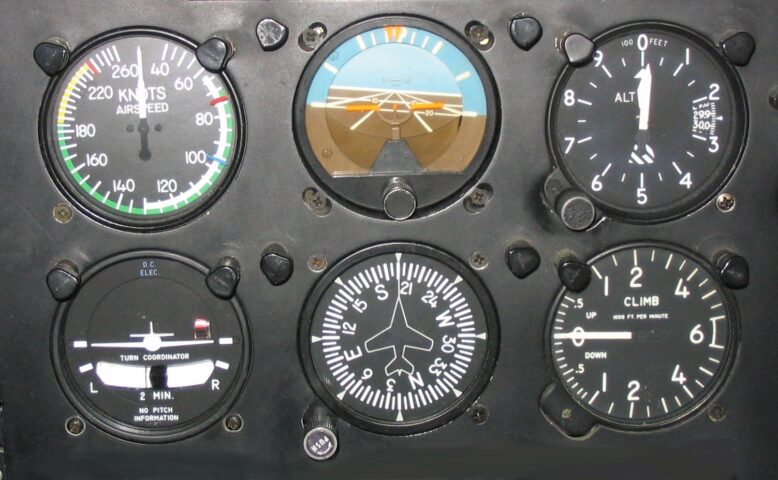
The Six-Pack: A Quick Overview
The six primary flight instruments have been arranged in the same basic pattern since the 1930s. The British Royal Air Force standardized this layout in 1937, and it’s stuck ever since.
Here’s the standard arrangement:
Top row (left to right):
- Airspeed Indicator
- Attitude Indicator
- Altimeter
Bottom row (left to right):
- Turn Coordinator
- Heading Indicator
- Vertical Speed Indicator
The instruments are grouped by function. The three most critical instruments — airspeed, attitude, and altimeter — sit across the top where they’re easiest to scan. This arrangement isn’t arbitrary. It’s designed for efficient scanning and quick interpretation, especially when you’re flying in clouds or darkness and can’t see the horizon.
Two Systems: Pitot-Static and Gyroscopic
The six instruments draw their information from two completely different systems.
Three instruments use the pitot-static system — they measure air pressure:
- Airspeed Indicator
- Altimeter
- Vertical Speed Indicator
Three instruments use gyroscopes — they track orientation and rotation:
- Attitude Indicator
- Heading Indicator
- Turn Coordinator
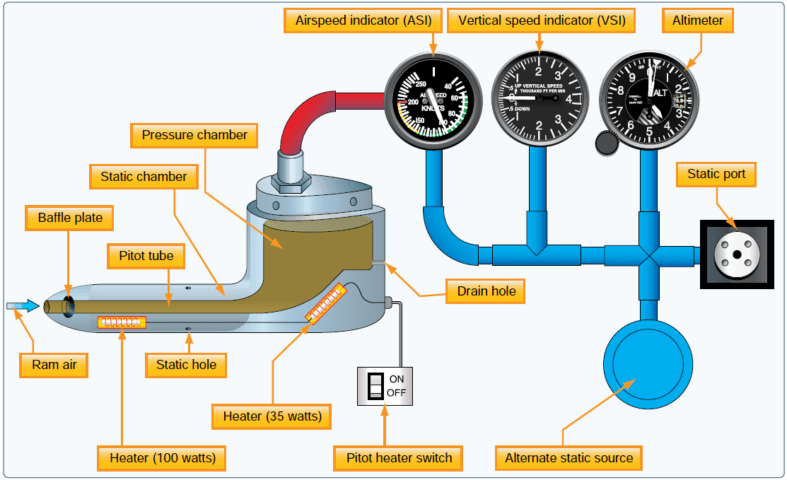
Understanding which instruments rely on which system becomes critical when something goes wrong. A blocked pitot tube affects all three pitot-static instruments. A vacuum pump failure knocks out the gyroscopic instruments. Knowing what failed and what still works can save your life.
Airspeed Indicator: How Fast You’re Moving Through the Air
The airspeed indicator (ASI) is the only instrument connected to both the pitot tube and the static port. It measures the difference between ram air pressure and static pressure, and displays that difference as airspeed, usually in knots (nautical miles per hour).
The ASI has color-coded arcs that tell you at a glance whether you’re flying too slow, too fast, or right where you should be. The white arc marks the flap operating range. The green arc is the normal operating range. The yellow arc is the caution range. The red line is the never exceed speed.
Here’s something that confuses people: the airspeed indicator doesn’t tell you how fast you’re moving over the ground. That’s groundspeed. The ASI shows indicated airspeed (how fast you’re moving through the air mass around you). Technically, how fast you’re moving through the air is true air speed (TAS), but the differences between ASI and TAS are for another post. The wings generate lift based on airspeed, not groundspeed.
Altimeter: How High You Are
The altimeter measures altitude by sensing changes in atmospheric pressure. As you climb, pressure decreases. The altimeter converts that pressure change into an altitude display with three hands showing 10,000-foot, 1,000-foot, and 100-foot increments.
The altimeter has a Kollsman window where you set the current barometric pressure. Before every flight, you adjust this to match the local altimeter setting. Why? Atmospheric pressure changes constantly. If you don’t update it, your altitude display drifts. The saying goes: “High to low, look out below.” Flying from high to low pressure without updating makes the altimeter read higher than actual and you’re lower than you think.
Vertical Speed Indicator: How Fast You’re Climbing or Descending
The vertical speed indicator (VSI) shows your rate of climb or descent in feet per minute. It’s useful but laggy. It takes several seconds to stabilize after a pitch change. Don’t chase the VSI needle. Use the altimeter and attitude indicator instead, then cross-check the VSI to verify your climb or descent rate.
Attitude Indicator: Your Artificial Horizon
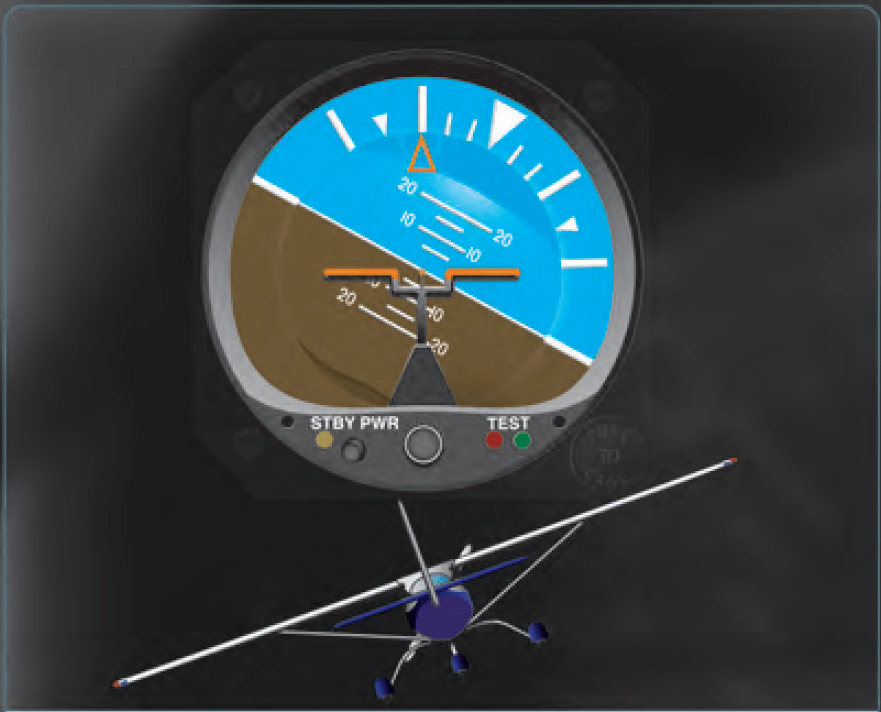
The attitude indicator (AI) (sometimes called the artificial horizon) is the single most important instrument for flying in clouds or at night. It’s the only instrument that shows both pitch and bank simultaneously.
The AI has a gyroscope spinning in the horizontal plane. The gyro stays fixed relative to the real horizon. As the airplane pitches or banks, the AI shows your attitude relative to that fixed reference. The display shows a miniature airplane sitting on a horizon line. Above the line is blue (sky), below is brown or black (ground).
Heading Indicator: Which Way You’re Pointed
The heading indicator (HI), also called the directional gyro (DG) shows your magnetic heading. It looks like a compass, but it’s far more stable during turns and maneuvers. The HI uses a gyroscope and doesn’t sense magnetic north directly. You set it manually by comparing it to the magnetic compass, then it holds that heading.
The problem is gyroscopic precession. The heading indicator drifts about 3 degrees every 15 minutes. You need to reset it periodically. Why not just use the magnetic compass? Because the compass is unreliable during turns, climbs, and descents. The HI is rock-solid, but it needs periodic realignment.
Turn Coordinator: Rate of Turn and Coordinated Flight
The turn coordinator shows your rate of turn and whether the turn is coordinated. When the wingtip aligns with a tick mark, you’re in a standard-rate turn of 3 degrees per second. In other words, it will take 2 minutes to make a 360 degree turn.
Below the turn rate display is a ball in a curved glass tube called the inclinometer. In coordinated flight, the ball stays centered. If it moves left, add left rudder. If it moves right, add right rudder. The old saying is “step on the ball.”
The Instrument Scan
Flying by instruments isn’t about staring at one gauge. It’s about scanning — moving your eyes in an organized pattern across all six instruments, gathering information, and building a mental picture of what the airplane is doing.
A common scan pattern is the “T” scan. Start at the attitude indicator (center), check the airspeed indicator (left), back to the attitude indicator, check the altimeter (right), back to the attitude indicator, check the heading indicator (below), back to the attitude indicator. The attitude indicator is the hub. Everything else is cross-checked against it.
What Happens When Something Fails
Understanding the systems behind these instruments matters because failures happen. If the pitot tube ices over, the airspeed indicator freezes or gives false readings. If the static port gets blocked, all three pitot-static instruments fail. If the vacuum pump fails, the attitude and heading indicators slowly spin down.
Pilots train for these scenarios. Flying with some instruments failed (called partial panel flying) is a required skill for the instrument rating.
Why This Matters Before You Solo
Your instructor will start teaching you the six-pack on your very first lesson. Long before you’re flying in clouds, you’ll be learning to cross-check your instruments in visual conditions.
Why? Because relying solely on what you see outside is dangerous. Visibility changes. Weather moves in. Haze makes the horizon disappear. At night, there is no horizon. The instruments don’t lie, but your senses do.
Spatial disorientation kills experienced pilots every year. The only defense is trusting your instruments. The six-pack has been the foundation of flight safety for nearly a century, so it pays to learn it well.
Ready to see what you remember? Take this quiz!